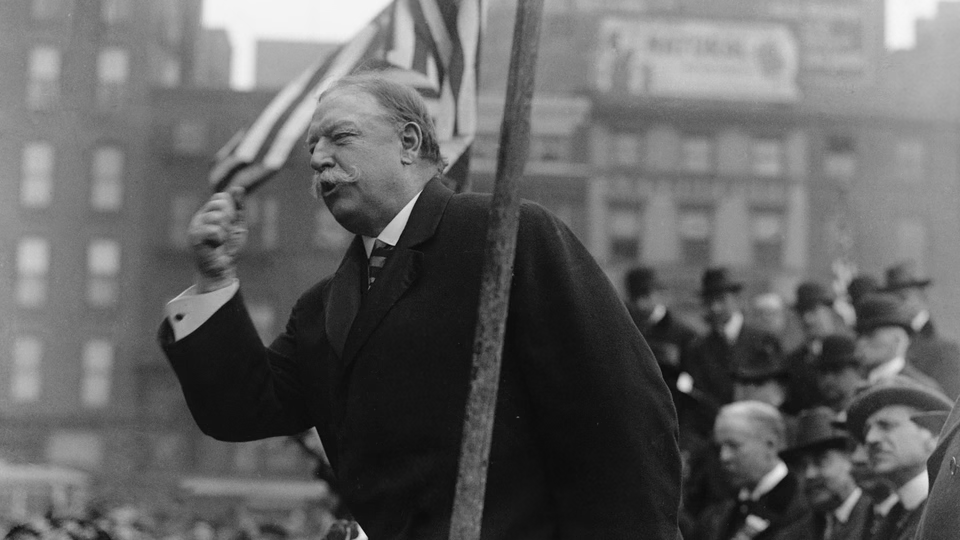
madtechventures.com – William Howard Taft’s presidency, which spanned from 1909 to 1913, was marked by significant political and ideological divides that shaped his administration and ultimately affected his legacy. While Taft entered office with the endorsement of Theodore Roosevelt, his close political ally and predecessor, his time in the White House became defined by a rift between the two men, leading to a split in the Republican Party. The divisions during his presidency had lasting consequences for both Taft and the Republican Party, influencing the course of American politics for years to come.
Taft’s ability to navigate the political landscape, manage internal party divisions, and tackle key issues of his time such as tariffs, business regulation, and foreign policy left a deep impact on American governance. His presidency, though often overshadowed by the rise of progressivism and the election of Woodrow Wilson in 1912, was marked by both successes and challenges that reflect the complexities of governing during an era of rapid change.
In this article, we will explore the dynamics of Taft’s presidency, focusing on the political challenges he faced, his relationship with Roosevelt, his stance on key domestic issues, and his role in the broader context of American politics.
Early Years and the Path to the Presidency
The Roosevelt Connection
William Howard Taft was initially handpicked by Theodore Roosevelt to be his successor, a decision that was meant to ensure the continuation of Roosevelt’s progressive policies. Roosevelt had brought about significant reforms during his presidency, particularly in areas such as trust-busting, conservation, and labor rights. He saw Taft, his close friend and trusted ally, as a man who could carry forward these initiatives. Taft, a former judge and administrator in the Philippines, had earned Roosevelt’s trust for his reputation as an effective, albeit more cautious, reformer.
When Taft ran for president in 1908, Roosevelt’s endorsement helped propel him to victory, as he campaigned on a platform of progressive reform, promising to continue Roosevelt’s domestic and foreign policies. However, the political honeymoon between Taft and Roosevelt would not last long. While Taft shared many of Roosevelt’s goals, their approaches to governance and specific policies quickly began to diverge.
The Strains of Leadership
Upon entering office, Taft was confronted with immediate challenges. His more conservative approach to some issues clashed with Roosevelt’s more aggressive progressive stance. Although Taft initially made efforts to maintain Roosevelt’s policies, he soon developed his own leadership style, leading to growing tensions between the two.
One of the major early sources of friction was Taft’s approach to trust-busting. While Roosevelt had been proactive in targeting monopolistic corporations, Taft took a more cautious and legalistic approach, preferring to pursue cases through the courts rather than through regulatory measures. This difference in strategy created a rift between the two men, as Roosevelt believed Taft was not doing enough to dismantle the power of big corporations.
The Political Divide: Taft vs. Roosevelt
The Tariff Controversy
One of the most significant political divides during Taft’s presidency occurred over the issue of tariffs, which were central to the economic and political debates of the time. Taft inherited the tariff issue from Roosevelt, who had worked to reduce tariffs but had faced opposition from conservative Republicans in Congress. Tariffs were an important issue for both progressives and conservatives, as they directly impacted business interests, consumer prices, and the economy.
In 1909, Taft supported the Payne-Aldrich Tariff, which ultimately raised tariffs on many goods instead of lowering them as he had promised during his campaign. This decision infuriated progressives in his party, who believed that reducing tariffs would benefit consumers by lowering the cost of goods. Taft’s inability to fully deliver on his campaign promise to reform tariffs led to a loss of support among progressive Republicans, particularly those aligned with Roosevelt.
Roosevelt, who had been a champion of tariff reduction, saw Taft’s stance as a betrayal of the progressive cause. The conflict over the tariff issue marked the beginning of a deepening divide between the two men and their respective political factions.
The Republican Split
The 1910 midterm elections further exposed the growing schism within the Republican Party. Progressives, unhappy with Taft’s conservatism, began to rally behind Roosevelt, who publicly criticized Taft’s policies and actions. By 1912, Roosevelt, frustrated with Taft’s leadership, decided to challenge him for the Republican nomination, further dividing the party.
Roosevelt’s decision to run for president again was a pivotal moment in American politics. The Republican Party, once united under Roosevelt’s leadership, was now fractured into two factions: the conservative wing, led by Taft, and the progressive wing, led by Roosevelt. The bitter contest for the Republican nomination in 1912 created a political crisis for the party, weakening its ability to win the general election.
The Election of 1912 and Its Aftermath
The political battle between Taft and Roosevelt reached its climax in the 1912 election. Roosevelt, unable to secure the Republican nomination, ran as the candidate of the newly formed Progressive Party, also known as the “Bull Moose Party.” Taft, the incumbent president, was the Republican nominee, while Woodrow Wilson, the governor of New Jersey, emerged as the Democratic nominee.
The division within the Republican Party proved disastrous for Taft. With Roosevelt’s supporters defecting to the Progressive Party, Taft’s chances of winning the presidency were severely diminished. In the general election, Wilson triumphed with a clear majority, and Taft finished a distant third, with Roosevelt placing second. Wilson’s victory marked the beginning of a new era in American politics, with the Democrats taking control of the White House for the first time in 16 years.
The split in the Republican Party had long-term consequences, weakening the party and paving the way for a period of Democratic dominance in American politics. Taft’s inability to navigate the political divide between the conservative and progressive wings of his party contributed to his defeat and the decline of the Republican Party’s influence during the early 20th century.
Taft’s Domestic Policy: Progressivism and Conservatism
Trust-Busting and Regulation
Despite the political turbulence surrounding his presidency, Taft’s administration was marked by significant efforts to regulate big business and monopolies. Taft continued Roosevelt’s trust-busting policies, filing more antitrust lawsuits than any previous administration. Under his leadership, the Justice Department broke up companies such as Standard Oil and American Tobacco, seeking to promote fair competition and prevent the concentration of economic power in the hands of a few corporations.
However, Taft’s cautious approach to trust-busting, combined with his reluctance to use executive orders and his preference for legal proceedings, led some progressives to criticize him for not being aggressive enough in regulating corporate interests. While his efforts were significant, they did not have the same immediate impact or widespread support that Roosevelt’s more hands-on approach had enjoyed.
Conservation and Environmental Protection
Another area where Taft faced criticism from progressives was in his stance on conservation. Roosevelt had made environmental conservation a cornerstone of his presidency, establishing national parks, forests, and monuments. Taft, however, was less committed to the conservation movement, and his administration was seen by many as more sympathetic to business interests, particularly those involved in resource extraction.
Taft’s decision to dismiss Gifford Pinchot, the chief of the U.S. Forest Service and a strong advocate for conservation, further alienated progressive environmentalists. Pinchot’s removal from office came after a dispute over the secretary of the interior’s management of public lands, and it underscored Taft’s more conservative approach to conservation issues.
Labor Rights and Reforms
Taft did make some strides in labor reform, although his efforts were often overshadowed by the political turmoil within his own party. His administration created the Department of Labor in 1913, a significant step in addressing the needs of workers and labor organizations. Taft also supported child labor laws and regulations to improve workplace safety, although these efforts were often constrained by political opposition.
Foreign Policy and Global Leadership
Taft’s Diplomacy and “Dollar Diplomacy”
In terms of foreign policy, Taft sought to expand American influence globally through a policy known as “Dollar Diplomacy.” This approach emphasized the use of economic and financial investments to promote American interests abroad, particularly in Latin America and Asia. Taft believed that by investing in foreign economies, the United States could foster stability and secure favorable trade relationships.
One of the key elements of Dollar Diplomacy was Taft’s support for American businesses and banks investing in Latin American countries and China. While the policy was intended to prevent European powers from gaining influence in these regions, it was often criticized for prioritizing American corporate interests over the well-being of local populations. Dollar Diplomacy had limited success, as it failed to garner widespread support both at home and abroad.
Conclusion: The End of Taft’s Presidency
William Howard Taft’s presidency was marked by a profound political divide within the Republican Party, as well as significant challenges in navigating the complexities of domestic and foreign policy. His inability to reconcile the competing interests of the conservative and progressive factions of his party led to a fractured Republican electorate and ultimately to his defeat in the 1912 election. Despite his political struggles, Taft’s presidency made lasting contributions to American law and governance, particularly in the areas of trust-busting, labor reform, and judicial appointments.
Taft’s presidency serves as a reminder of the challenges that come with managing a divided political landscape. His legacy is a complex one—marked by both significant reforms and deep political fractures. His story is a testament to the difficulties of governing in a time of intense ideological conflict and political change, a theme that continues to resonate in American politics today.